
Previous Residents of a Randolph Address
A backward address search changes sources as it crosses eras. Norfolk land records establish title and survive much farther back than most local occupancy records. Randolph directories and voting lists place names at addresses only for their listed years. Census schedules describe households at an enumeration date, not every move between censuses. Permits, newspapers, maps, and probate files add events or context. Start with the era that matches the question, then use the next source to test rather than merely repeat the first result.
| Historical source | Randolph coverage | Where to use it | What it can show |
|---|---|---|---|
| Norfolk Recorded Land | 1793-present; scanned index 1793-1955 | Registry online system and research terminals | Grantor, grantee, instrument, title reference, legal description, image |
| Norfolk Registered Land | 1900-present | Registry and Land Court route | Certificate of title and registered instruments |
| Registry transcriptions | 1793-1900 | Norfolk Registry genealogy material | Typed aid for cursive land records |
| Randolph directories | Discontinuous 1884-1950 holdings | State Library and partner scans | Name, address, occupation or business, street section |
| Randolph voting lists | Discontinuous 1932-1989 holdings | State Library | Historical voter names, addresses, and list status as printed |
| Federal census | Released through 1950 | NARA, Census, or FamilySearch | Household composition at the enumeration date |
| Turner newspaper archive | Herald 1967-1993; Mariner 1985-1990 | Turner digital archive | Announcements, obituaries, addresses, civic events |
| Sanborn map | September 1897 | Library of Congress | Building footprints, uses, and street context |
Past residents require an era match. A name in a directory is occupancy evidence for that directory's date, whereas a deed identifies a legal title transaction rather than all occupants.
Start Randolph Previous Residents With the Parcel
Use the Randolph Vision assessment database as a current index lead. Copy the present owner name, situs address, mailing address, parcel or map reference if shown, property class, lot and building details, exemptions, sketch, and sales history. The situs is where the parcel sits. The mailing address is where the tax correspondence goes. A legal description or parcel reference is the bridge that is most likely to survive a changed address string.
Next, view the parcel in Randolph MapGeo and compare its boundary with nearby plans or records. The card is not a certified deed and does not establish that the owner lives at the parcel. It is the strongest present-day starting point because it provides the name and property keys needed to search the county index.
Follow a Randolph Address Through Norfolk Deeds
The county chain begins by checking the current owner in the Norfolk land-record research system. On the purchase deed, copy the seller, recording date, book and page or document number, plan reference, and full legal description. Search the seller as a prior grantee, then repeat. Search names, legal descriptions, plans, neighboring owners, and old street forms when a current address does not retrieve an older record.
- Open the current Randolph parcel card and record its owner and title-related identifiers without treating the card as final proof.
- Find that owner's acquisition deed using the Randolph town filter and a likely date range, then verify the property by legal description or plan.
- Record the grantor, the seller who conveyed the property, and the prior deed reference before leaving the image.
- Search the seller as grantee in earlier records and repeat the same review, keeping a dated chain rather than a loose name list.
- When the chain stops at a death or inheritance, shift to Norfolk Probate and Family Court rather than assuming a missing sale.
- Grantor and grantee
- The grantor transfers an interest in property; the grantee receives it. A later deed can make the earlier grantor the next person to search as a grantee.
- Chain of title
- A dated sequence of recorded transfers or other title events that connects one owner to an earlier owner.
- Legal description
- The lot, plan, boundary, or other title wording used to identify property. It can remain useful when a street number does not.
- Criss-cross directory
- A reverse or street section that may group historical directory entries by address. The exact Randolph reverse-directory run was not located.
- Enumeration district
- The census area's administrative label for a particular census. It helps locate the correct schedule but is not a parcel or deed identifier.
Note: Norfolk's index separates Recorded Land from Registered Land, so a search that fails in one system should be tested in the other.
Randolph Previous Residents Need Both Land Indexes
Norfolk Recorded Land and Registered Land are distinct index systems. About 80 percent of Norfolk property is Recorded Land and about 20 percent is Registered Land, according to the Registry's research information. Address searching is a combined exception, but addresses were included systematically for applicable documents only from 2003. Earlier Randolph history therefore often requires the party names, plan, book and page, or legal description preserved in the deed itself.
The Registry's 1793-1900 transcription project is helpful when cursive slows the search, but a transcription does not replace the original image where a spelling or boundary matters. Free online images carry the Registry's “Not An Official Copy” overlay. Its public terminals, copy routes, and official-image process remain useful fallbacks when a printed or certified record is needed.
Pair Randolph Previous Residents With Census Years
Ownership is only one part of an address history. For occupancy, begin with a Randolph directory near a federal census year, preserve the printed name, address, occupation, and any relationship or widow notation, then check the street section for other names at that number. Search the prior and following directory years for the same address and nearby surnames. The census then tests household composition at its own enumeration date.
- Choose a cataloged directory or voting-list year close to the period in question and copy its page information before drawing a conclusion.
- Check the address and the name separately, including initials, abbreviated street forms, and spouse or widow notation.
- Pair that entry with the nearest released federal census, remembering that the 1890 population schedules are missing and census availability follows the 72-year rule.
- Use deeds for ownership, directories for dated occupancy, and census schedules for a household snapshot. Do not collapse those roles into one fact.
The cataloged volumes and their access limits are described in the Randolph Directory Book. That collection work is separate from tracing one address back through time.
Randolph's 1897 Map Bridges House History
The Library of Congress Randolph Sanborn map consists of seven sheets dated September 1897. It can show the built setting of an address at a fixed point: building footprints, uses, and street context. Pair it with the nearby 1884, 1891, 1895, or 1898 directory holdings and the 1890 directory as a substitute clue for the missing federal population schedules.
Sanborn evidence identifies the physical setting, not a household. It is most valuable when a deed legal description, a historic directory address, and a present parcel need a careful visual bridge. Street-scene photographs in Turner Free Library's digital history collection can add another check on a building or landmark.
Randolph Previous Residents: Probate Endpoints
When a deed chain reaches a deceased owner, inherited title may have passed through probate rather than a new deed. Norfolk Probate and Family Court holds estate records that can connect heirs, personal representatives, wills, inventories, and property references. Public docket information is searchable through MassCourts, while the Canton court's public terminal and physical file remain the routes for the official record. Impounded, sealed, juvenile, adoption, and protected-family material is restricted.
Newspapers and obituaries can suggest a move, death, former address, or family relationship. Turner Free Library's archive contains the Randolph Herald from 1967-1993 and the Randolph Mariner from 1985-1990. Treat a notice as a lead, then verify it against a deed, probate record, or vital record. An obituary that says someone was “of Randolph” does not itself prove ownership or an address date.
Randolph Previous Residents and the House-History Method
A house history works best when the deed trail and household trail are kept side by side. The Northeast House Historian's Randolph sequence points researchers to county deeds, FamilySearch land records, probate, local directories, and newspapers. It is a useful finding aid because it recognizes that no single collection provides a complete previous-residents list. Verify its leads with the official Registry, court, archive, and library sources before relying on a fact.
The Northeast House Historian Randolph guide illustrates the local house-history sequence.
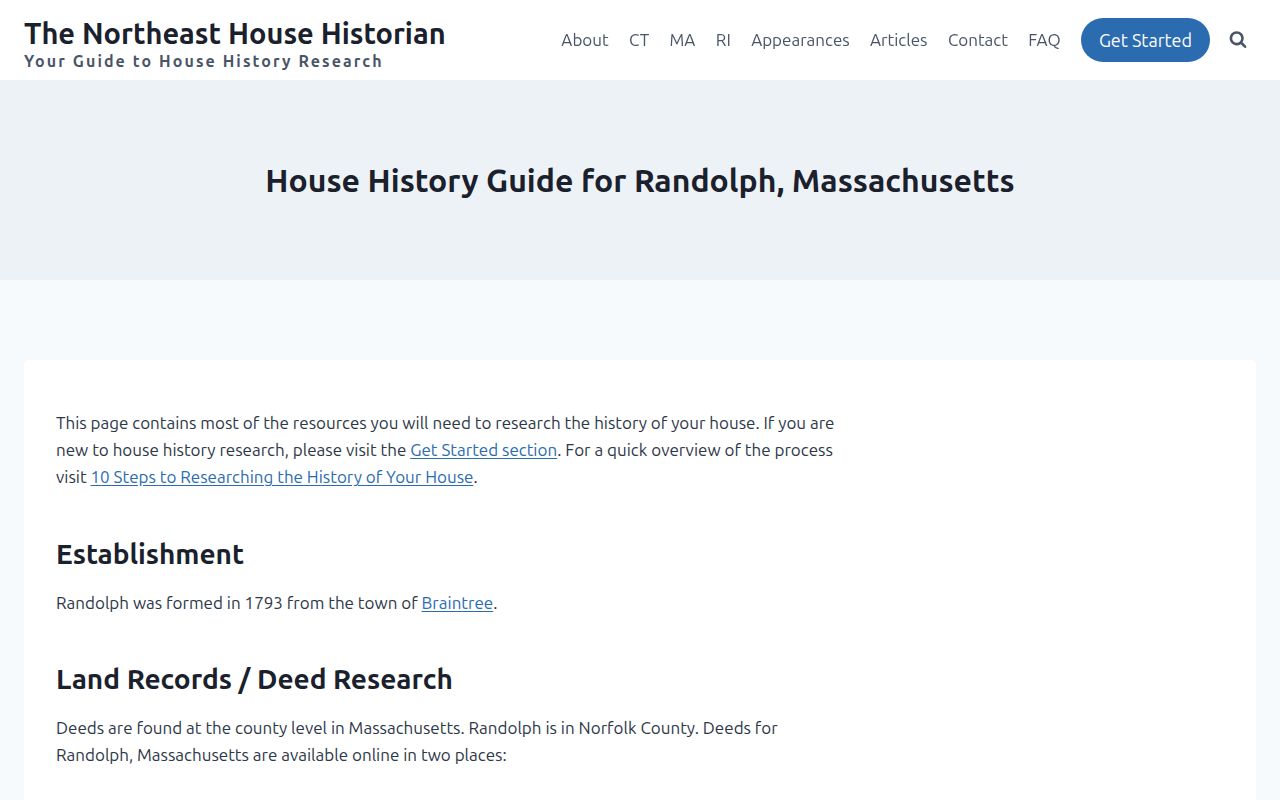
Its sequence reinforces the practical divide: deeds explain title, while directories, census schedules, newspapers, and probate add the people and dates around a property.
Randolph Previous Residents May Meet Collection Gaps
Turner Free Library's original building and most of its contents were destroyed by fire on December 6, 1962. The library resumed service the same day with six books in borrowed Congregational Church space, later using a volunteer station wagon until the rebuilt library reopened in 1966. That local history explains why an absent printed source is not proof that the address trail has ended.
Cross-check a missing local item against the State Library, Massachusetts Archives, FamilySearch, the Norfolk Registry, and Turner digital history material. This preserves a useful distinction between a genuine record gap and a collection gap caused by where a surviving item is held.
Keep Randolph Address Continuity in View
Randolph was formed from Braintree in 1793, so research before that year may belong in Braintree records or a different jurisdictional context. No official Randolph street-renumbering or street-renaming chronology was located. Preserve every spelling, street abbreviation, plan reference, and adjacent parcel from the source. Test the historical record through the legal description and owner sequence instead of assigning an unsupported new number to an old address.
Note: The strongest prior-resident trail records the source date and source type for each name, then leaves uncertainty visible where the records do not connect.
Randolph Previous Residents Have Privacy Boundaries
Older public records can support family history and a home's past, but they do not authorize tracking a living person. Massachusetts protects confidential voters, Address Confidentiality Program participants, sealed and impounded court material, adoption records, and other restricted information. A record of ownership, a historic directory entry, or a newspaper notice should not be used to infer every current household member or private contact detail.
Lawful use. Randolph house-history research is appropriate for personal and family-history questions; never use a past address trail to stalk, harass, intimidate, or expose anyone.